
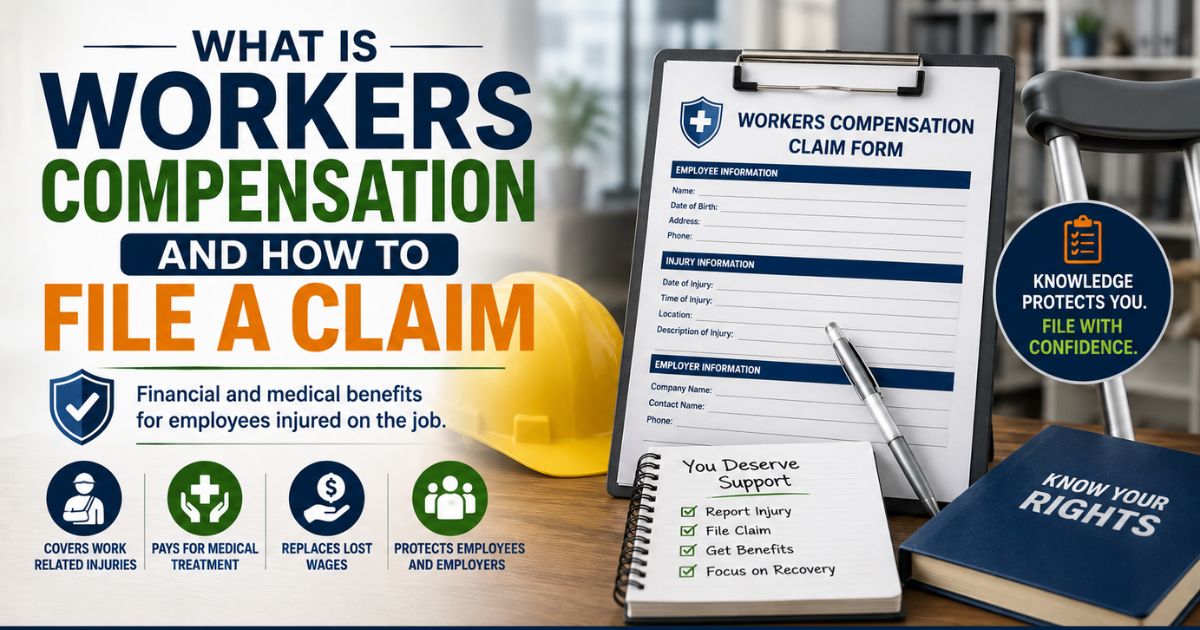

Getting hurt at work changes everything in an instant. One moment you’re doing your job, the next you’re facing medical bills, lost wages, and uncertainty about your future. Workers compensation exists to protect you during these moments, but most people don’t understand how it works until they desperately need it.
Workers compensation is a state-mandated insurance system that provides medical treatment, wage replacement, and other benefits to employees injured on the job. It’s designed to help workers recover without facing financial ruin, while protecting employers from lawsuits. Whether you’re a construction worker who fell from scaffolding, an office employee with carpal tunnel syndrome, or a retail worker injured by falling merchandise, understanding your rights under workers comp can mean the difference between a smooth recovery and financial hardship. This guide explains exactly what workers compensation covers, who qualifies, how the system works, and the precise steps to file a claim that gets approved.
What Workers Compensation Covers
Workers compensation provides several types of benefits when you’re injured or become ill because of your job.
Medical Benefits
Workers comp pays for all reasonable and necessary medical treatment related to your workplace injury or illness. This includes:
- Emergency room visits and ambulance transportation
- Doctor appointments and specialist consultations
- Surgery and hospital stays
- Prescription medications
- Physical therapy and rehabilitation
- Medical equipment like crutches, wheelchairs, or braces
- Ongoing treatment for chronic conditions caused by work
The insurance company typically directs you to approved healthcare providers within their network. In most states, you must treat with company-approved doctors, at least initially. Some states allow you to choose your own physician after a waiting period.
Wage Replacement Benefits
When your injury prevents you from working, workers comp replaces a portion of your lost income. These are called temporary disability benefits.
Temporary Total Disability (TTD): If you can’t work at all during recovery, you receive weekly payments typically equal to two-thirds of your average weekly wage. Each state sets maximum weekly amounts. For example, you might earn $900 weekly, but TTD pays only $600.
Temporary Partial Disability (TPD): If you return to work with reduced hours or lighter duties at lower pay, TPD benefits make up part of the wage difference.
Permanent Disability: If your injury causes lasting impairment, you may receive permanent disability benefits. These are calculated using complex formulas based on your impairment rating, age, occupation, and state guidelines.
Most states don’t pay benefits for the first few days of disability unless your injury keeps you out of work beyond a certain period (often 14 days).
Vocational Rehabilitation
If your injury prevents you from returning to your previous job, some states require the insurance company to provide vocational rehabilitation services. This might include:
- Job retraining programs
- Education assistance
- Resume writing and interview coaching
- Job placement services
Death Benefits
When a workplace injury or illness causes death, workers compensation provides benefits to surviving dependents. These typically include:
- Burial expenses (usually capped at $5,000-$15,000 depending on state)
- Weekly payments to spouses and dependent children
- Lump-sum payments in some jurisdictions
Who Is Covered by Workers Compensation
Eligible Employees
Nearly all employees are covered by workers compensation, including:
- Full-time workers
- Part-time workers
- Temporary employees
- Seasonal workers
- Minors (with special provisions)
- Undocumented workers (in most states)
Coverage applies regardless of who caused the accident. You receive benefits even if the injury was entirely your fault.
Common Exclusions
Some workers fall outside standard workers compensation coverage:
Independent Contractors: If you’re classified as an independent contractor rather than an employee, you’re typically not covered. However, misclassification is common, and many workers labeled as contractors are legally employees entitled to benefits.
Business Owners and Partners: Sole proprietors, partners, and LLC members often aren’t required to carry coverage for themselves, though they may purchase optional coverage.
Agricultural Workers: Some states exclude farm workers or small agricultural operations.
Domestic Workers: Requirements vary significantly by state. Some mandate coverage for household employees; others don’t.
Volunteers: Generally not covered unless specifically included under state law.
Federal Employees: Covered under separate federal programs (FECA) rather than state workers comp systems.
Employer Requirements
Most states require businesses to carry workers compensation insurance once they have a minimum number of employees—often just one employee. Requirements vary:
- Texas is the only state where workers comp is optional for most private employers
- Some states exempt businesses with fewer than 3-5 employees
- Agricultural and construction industries often have different thresholds
- Corporate officers may be excluded or included depending on state law
Employers who don’t carry required coverage face serious penalties, including fines, criminal charges, and civil liability for injured workers.
Types of Injuries and Illnesses Covered
Acute Injuries
These are sudden incidents that cause immediate harm:
- Falls from heights or on slippery surfaces
- Being struck by falling objects or equipment
- Car accidents while driving for work
- Machinery accidents
- Burns from chemicals or fire
- Cuts and lacerations
- Broken bones and fractures
- Head injuries and concussions
The injury must occur during work-related activities. Your morning commute doesn’t count, but traveling between job sites during the workday does.
Occupational Diseases
Workers comp covers illnesses that develop gradually due to workplace conditions:
- Respiratory diseases from chemical exposure or poor air quality (asbestosis, silicosis)
- Repetitive stress injuries like carpal tunnel syndrome
- Hearing loss from prolonged noise exposure
- Skin conditions from chemical contact
- Certain cancers linked to workplace carcinogens
- Infectious diseases contracted through work (especially relevant for healthcare workers)
These claims are more complex because you must prove the illness resulted from workplace conditions rather than non-work factors.
Mental Health Conditions
Coverage for psychological injuries varies significantly by state:
- Physical-mental claims: Mental conditions resulting from physical injuries (like depression after a severe accident) are generally covered
- Mental-mental claims: Psychological injuries without physical trauma (like PTSD from witnessing a traumatic event) have limited coverage in many states
- Stress claims: Work-related stress is typically excluded unless it’s extraordinary compared to normal workplace stress
Pre-Existing Conditions
Having a pre-existing condition doesn’t automatically disqualify you. If your work aggravates or accelerates an existing condition, you may receive benefits for the worsened portion. For example, if you had mild arthritis that became severely disabling due to repetitive work tasks, workers comp should cover the aggravation.
What Workers Compensation Doesn’t Cover
Understanding exclusions prevents claim denials and frustration.
Self-Inflicted Injuries
Injuries you intentionally cause yourself aren’t covered. This includes suicide attempts, except in rare cases where severe work-related PTSD is proven.
Intoxication and Drug Use
If you were intoxicated or using illegal drugs at the time of injury, your claim will likely be denied. Insurance companies often require drug testing after accidents. However, some states allow claims if you can prove intoxication didn’t cause the injury.
Horseplay and Fighting
Injuries from workplace fights, pranks, or horseplay are typically denied unless you were an innocent victim of someone else’s actions.
Off-Duty Activities
Company picnics, holiday parties, and other social events usually aren’t covered unless attendance was mandatory or the event provided significant business benefit to the employer.
Violation of Company Policy
Some states deny claims when injuries occur while violating significant safety policies, though this is highly fact-specific. Simply violating a rule doesn’t automatically bar benefits if the violation didn’t cause the injury.
Commuting
Your regular commute to and from work isn’t covered. Exceptions include:
- Traveling between job sites during work hours
- Making work-related errands
- Having no fixed workplace
- Being on-call and responding to emergencies
How to File a Workers Compensation Claim: Step-by-Step
Filing correctly from the start dramatically increases your chances of approval.
Step 1: Report Your Injury Immediately
Notify your supervisor or employer as soon as the injury occurs—ideally within hours, certainly within days.
Why timing matters: Every state has strict deadlines for reporting injuries, ranging from 24 hours to 30 days. Missing this window can result in claim denial or reduced benefits.
How to report:
- Tell your direct supervisor verbally
- Follow up with written notice (email or company incident report form)
- Keep copies of all documentation
- Include the date, time, location, what happened, and witnesses
- Describe all injuries, even minor ones
Don’t downplay injuries or say “I’m fine” if you’re hurt. Insurance companies use your initial statements against you.
What to avoid:
- Don’t wait to see if the injury gets better
- Don’t assume minor injuries don’t qualify
- Don’t let supervisors convince you to wait or “think about it”
Step 2: Seek Medical Treatment
Get medical attention immediately for serious injuries. For less severe injuries, see a doctor within 24-48 hours.
Company-approved doctors: Most states require you to treat with the employer’s designated medical provider, at least initially. Ask your employer for the approved provider list.
Emergency treatment: If it’s a genuine emergency, go to the nearest ER. You can transfer to approved providers later.
Independent medical evaluation: Some states allow you to see your own doctor after a certain period or number of visits.
Medical documentation tips:
- Describe all symptoms completely and accurately
- Explain that the injury happened at work
- Follow all treatment recommendations
- Attend all appointments
- Keep copies of medical records, prescriptions, and bills
- Don’t exaggerate, but don’t minimize injuries either
Missing appointments or refusing treatment gives insurance companies grounds to reduce or deny benefits.
Step 3: Complete the Workers Compensation Claim Form
Your employer should provide the official claim form (sometimes called “First Report of Injury”). If they don’t, contact your state’s workers compensation board to obtain one.
Key information you’ll need:
- Your personal information (name, address, Social Security number)
- Employer details (company name, address, supervisor)
- Injury details (date, time, location, what happened)
- Body parts injured
- Witnesses
- Medical treatment received
Completing the form:
- Be thorough and accurate
- Describe exactly how the injury occurred
- List all body parts affected
- Don’t leave sections blank—write “N/A” if something doesn’t apply
- Make copies before submitting
- Get a signed receipt showing when you submitted it
Step 4: Submit the Claim Form
File the completed claim form with your employer and the workers compensation insurance carrier. Deadlines vary by state but typically range from 30 days to two years from the injury date.
Filing methods:
- Give it directly to your supervisor or HR department
- Send certified mail with return receipt
- File electronically if your state allows
- Submit a copy to the state workers compensation board in some jurisdictions
Keep proof of submission. Employers and insurance companies sometimes claim they never received forms.
Step 5: The Insurance Company Investigation
Once filed, the insurance company has a specific timeframe (usually 14-90 days depending on state) to accept or deny your claim.
What they investigate:
- Whether the injury occurred at work
- Whether it happened during work duties
- The extent of your injuries
- Your medical history for pre-existing conditions
- Witness statements
- Video footage if available
- Your employment records
They may:
- Request a recorded statement (you’re usually required to cooperate, but be careful what you say)
- Send you to an independent medical examination (IME) with their doctor
- Have investigators conduct surveillance
- Review your social media accounts
During the investigation:
- Be honest but cautious in statements
- Don’t discuss the case on social media
- Don’t post photos of physical activities
- Continue medical treatment as prescribed
- Keep detailed records of all communications
Step 6: Claim Decision
The insurance carrier will either accept or deny your claim.
If accepted:
- You’ll receive written notification
- Medical bills will be paid directly to providers
- Disability benefit checks begin (typically every two weeks)
- Continue following medical advice
- Report changes in your condition
- Provide requested documentation promptly
If denied:
- You’ll receive a denial letter explaining why
- You have the right to appeal
- Deadlines for appeals are strict (often 30-90 days)
- Consider consulting a workers compensation attorney
Common Reasons Claims Are Denied
Understanding why claims fail helps you avoid these pitfalls.
Late Reporting
Failing to notify your employer within the state’s reporting deadline is the most common reason for denial. Some states are strict—even a one-day delay can disqualify you.
Insufficient Medical Evidence
Claims fail when medical records don’t clearly link the injury to workplace activities. Generic diagnoses without causation statements weaken your case.
Conflicting Statements
Inconsistent descriptions of how the injury occurred raise red flags. Your statement to your supervisor, on the claim form, to doctors, and to the insurance adjuster should match.
Pre-Existing Conditions
Insurance companies often claim injuries result from pre-existing conditions rather than work. Strong medical evidence showing aggravation or acceleration of the condition is crucial.
No Witnesses
Injuries that occur when you’re alone are harder to prove, though not impossible. Immediate reporting and consistent statements become even more important.
Injury Outside Work Duties
If you were injured while doing something outside your job responsibilities, the claim may be denied. The activity must be work-related.
Intoxication
Positive drug or alcohol tests usually result in automatic denial, though some states allow claims if you prove intoxication didn’t cause the injury.
Horseplay
Injuries from goofing around rather than working are typically denied unless you were an innocent bystander.
What to Do If Your Claim Is Denied
Denial isn’t the end. Most states have multi-level appeal processes.
Review the Denial Letter
The denial letter must explain why your claim was rejected. Common reasons include late reporting, lack of medical evidence, injury outside employment, or intoxication.
Request Reconsideration
Some insurance companies allow you to submit additional evidence and request reconsideration before formal appeals.
File a Formal Appeal
Each state has specific appeal procedures and strict deadlines (typically 30-90 days from the denial date).
The appeal process generally involves:
- Informal hearing or mediation: Many states require mediation before formal hearings
- Formal hearing: Similar to a trial, with testimony, witnesses, and evidence presented to a workers compensation judge
- Appeals board review: If you lose the hearing, you can appeal to the state workers compensation appeals board
- Judicial review: Final appeals go to state courts
Gather Additional Evidence
Strengthen your appeal with:
- Detailed medical records linking injury to work
- Witness statements
- Expert medical opinions
- Photographs of the accident scene or injuries
- Company safety records showing hazardous conditions
Consider Legal Representation
Workers compensation attorneys work on contingency (typically 15-25% of your benefits). They handle:
- Gathering medical evidence
- Deposing witnesses
- Negotiating settlements
- Representing you at hearings
- Navigating complex legal procedures
You’re not required to hire an attorney, but representation significantly increases success rates for denied claims.
How Much You’ll Receive in Benefits
Benefit amounts vary dramatically by state, injury severity, and wages.
Calculating Wage Replacement
Most states pay two-thirds (66.67%) of your average weekly wage, subject to maximum weekly limits.
Example calculation:
- Your gross weekly wage: $900
- Two-thirds: $600
- State maximum: $650
- Your weekly benefit: $600 (the lesser amount)
If you earned $1,500 weekly:
- Two-thirds: $1,000
- State maximum: $650
- Your weekly benefit: $650 (capped at maximum)
State Maximum and Minimum Benefits
Each state sets maximum and minimum weekly benefit amounts, adjusted annually. For 2026, maximums range from approximately $600 to over $2,000 depending on the state.
High-wage earners receive less than two-thirds of actual wages because of caps. Low-wage workers may receive minimum benefits even if two-thirds would be less.
Tax Implications
Workers compensation benefits are not taxable income at the federal or state level. This provides some offset to the reduced wage replacement rate.
Duration of Benefits
Temporary disability: Continues until you return to work, reach maximum medical improvement, or hit state-specific time limits (some states cap temporary benefits at 104 weeks, 400 weeks, or other limits).
Permanent disability: May be paid weekly for life, for a set number of weeks based on impairment rating, or as a lump-sum settlement.
Medical Benefits
Medical treatment has no dollar cap in most states. All reasonable and necessary treatment related to the injury should be covered indefinitely.
Settlement vs. Ongoing Benefits
As your case progresses, the insurance company may offer a settlement.
Types of Settlements
Stipulated settlements: You receive ongoing medical care and weekly benefits according to an agreed schedule. You can reopen the claim if your condition worsens.
Compromise and release: You receive a lump sum in exchange for closing the claim permanently. The insurer is released from all future obligations, including medical treatment.
Evaluating Settlement Offers
Consider these factors:
Future medical needs: If you’ll need ongoing treatment, a lump sum may not cover future medical expenses, especially for chronic conditions.
Financial situation: Lump sums are tempting if you’re facing foreclosure or other emergencies, but may not be in your long-term interest.
Return to work: If you can return to your previous job at full wages, a settlement makes more sense than if you’re permanently disabled.
Medicare implications: Settlement amounts may affect Medicare eligibility and coverage. Medicare Set-Aside accounts may be required.
State rules: Some states prohibit compromise and release settlements; others restrict them for serious injuries.
Working with Attorneys on Settlements
Attorneys evaluate whether offers are fair based on:
- Your impairment rating
- Future earning capacity
- Life expectancy
- Future medical needs
- Comparable settlements in your jurisdiction
Insurance companies often lowball initial offers. Experienced attorneys typically negotiate significantly higher settlements.
Returning to Work After an Injury
Modified Duty
Many injured workers return to modified or light-duty work before fully recovering. Modified duty might involve:
- Reduced hours
- No lifting restrictions
- Sedentary tasks
- Different job responsibilities
Benefits: You receive partial disability benefits to make up the wage difference between your light-duty pay and pre-injury wages.
Rights: Your employer must accommodate work restrictions, but only if suitable work is available. They’re not required to create positions that don’t exist.
Full Duty
Once your doctor releases you to full duty without restrictions, temporary disability benefits end. You return to your previous position at your previous wage.
Permanent Restrictions
If you have permanent limitations, your employer must provide reasonable accommodations if possible. If no suitable work exists, you may be terminated and receive permanent disability benefits or vocational rehabilitation.
Protection Against Retaliation
It’s illegal for employers to fire, demote, or otherwise retaliate against you for filing a workers compensation claim. However, they can terminate you for legitimate, non-retaliatory reasons unrelated to your claim.
Document any adverse actions that seem retaliatory and consult an employment attorney if necessary.
Common Mistakes That Jeopardize Claims
Not Reporting Immediately
Waiting days or weeks to report injuries gives insurance companies ammunition to deny claims. They’ll argue the injury didn’t really happen at work or isn’t serious.
Describing Injuries Incompletely
Reporting only the most obvious injury while ignoring secondary injuries creates problems later. If you hurt your back and shoulder in a fall, report both immediately—even if the back pain seems worse initially.
Failing to Follow Medical Advice
Missing appointments, refusing recommended treatment, or not following restrictions gives insurance companies reason to terminate benefits. They’ll claim you’re prolonging recovery.
Providing Recorded Statements Without Preparation
Insurance adjusters are trained to ask questions that elicit damaging answers. While you usually must cooperate, you can prepare carefully and answer only what’s asked without volunteering extra information.
Social Media Posts
Photos of you skiing, hiking, or doing physical activities—even if pre-injury or showing limited participation—are used to argue you’re not really injured. Set accounts to private and avoid posting anything about activities.
Exaggerating Injuries
Overstating limitations destroys credibility. If surveillance catches you doing activities you claimed were impossible, your entire claim becomes suspect.
Missing Independent Medical Examinations
Failing to attend IMEs the insurance company schedules can result in benefit suspension or termination.
Accepting Settlements Too Quickly
Initial settlement offers are rarely the best you can get. Have an attorney review any offer before accepting, especially compromise and release settlements that close your claim forever.
Working While Collecting Full Disability
Working while receiving temporary total disability benefits is fraud. Even small cash jobs can result in benefit termination and criminal charges.
Frequently Asked Questions
Can I be fired for filing a workers compensation claim?
No. Retaliatory termination for filing workers comp claims is illegal in all states. However, employers can fire you for legitimate reasons unrelated to your claim, such as company-wide layoffs or performance issues that predated your injury.
Do I need a lawyer for my workers comp claim?
Not always. Straightforward claims that are accepted and paid without issues don’t require attorneys. Consider hiring one if your claim is denied, you’re offered a settlement, you have permanent disability, you’re unable to return to work, or the insurance company stops paying benefits.
How long does a workers compensation claim take?
Accepted claims typically begin paying benefits within 14-30 days. Denied claims that go through appeals can take 6-18 months or longer. Complex cases involving permanent disability may take years to fully resolve.
Can I choose my own doctor?
Rules vary by state. Many require treatment with employer-designated providers initially. Some states allow you to select from an approved list. Others permit your own doctor after a certain period. Emergency treatment can occur anywhere; you transfer to approved providers after stabilization.
What if my employer doesn’t have workers compensation insurance?
If your employer is legally required to carry coverage but doesn’t, you have additional options beyond workers comp. You may sue your employer directly in civil court, file a claim with your state’s uninsured employer fund, or report the employer to state authorities for penalties.
Will filing a claim affect my employment?
Legally, no. Practically, some employers create hostile environments for injured workers, though this is illegal. Document any retaliatory treatment. Your job is protected while you recover, though long-term disabilities may eventually result in termination if no suitable work exists.
Can I collect workers comp and other benefits simultaneously?
Generally yes, with some offsets. You can typically collect workers comp and Social Security Disability Insurance (SSDI) simultaneously, though SSDI may be reduced. Unemployment benefits while on workers comp is usually not allowed since you’re not “able and available” for work.
What if I’m partially responsible for my injury?
Workers compensation is a no-fault system. You receive benefits even if the injury was entirely your fault, with exceptions for intentional self-harm, intoxication, or fighting.
How are permanent disability ratings determined?
Doctors assess your permanent impairment using standardized guides like the AMA Guides to the Evaluation of Permanent Impairment. Ratings consider the body part injured, severity of impairment, and lost function. Your rating translates to a specific number of benefit weeks or a dollar amount based on state formulas.
Can I reopen a closed claim?
If you settled with a stipulation, you may reopen the claim if your condition worsens within the timeframe allowed by your state. Compromise and release settlements typically prohibit reopening. Medical-only claims can sometimes be reopened if the injury causes later disability.
Key Takeaways
Workers compensation protects you when workplace injuries or illnesses prevent you from earning a living. The system provides medical care, wage replacement, and other benefits without requiring you to prove your employer was negligent.
Critical steps for successful claims:
- Report injuries immediately—within hours or days, not weeks
- Seek medical treatment right away from approved providers
- Complete claim forms thoroughly and accurately
- Follow all medical advice and attend appointments
- Document everything with copies and receipts
- Be honest but careful in statements to insurance adjusters
- Avoid social media posts about activities
- Meet all deadlines for filing and appeals
- Consider legal representation for denied claims or settlements
Every state operates differently, with varying benefits, deadlines, and procedures. Understanding your specific state’s rules is crucial.
Workers comp isn’t designed to make you whole—benefits typically replace only two-thirds of wages, capped at maximum amounts. But when you can’t work due to a job injury, these benefits prevent financial catastrophe while you recover.
The system can feel complicated and frustrating, especially when dealing with injuries and insurance companies simultaneously. Taking the right steps from the beginning—reporting promptly, documenting thoroughly, and following medical advice—gives you the best chance of receiving the benefits you’ve earned and deserve.