
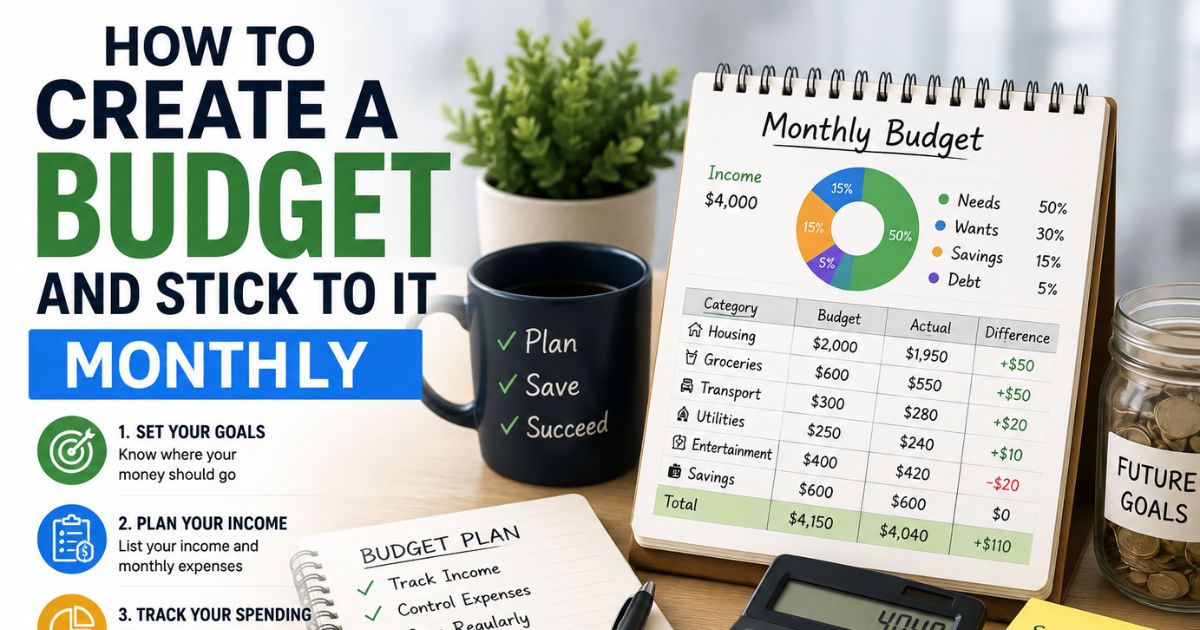

Most people don’t fail at budgeting because they can’t do math. They fail because their budget doesn’t reflect how they actually live.
Creating a budget takes an afternoon. Sticking to one requires a system that accounts for impulse purchases, forgotten subscriptions, irregular income, and the reality that life rarely follows a spreadsheet. This guide shows you how to build a monthly budget that bends without breaking—one that works with your psychology, not against it. You’ll learn practical frameworks used by financial counselors, behavioral adjustments that reduce overspending by up to 40%, and tracking methods that take less than five minutes daily. Whether you’re living paycheck to paycheck or trying to optimize substantial income, these strategies adapt to your situation.
Why Most Budgets Fail Within 30 Days
The average person abandons their budget within three weeks. Not because budgeting is complicated, but because most approaches ignore human behavior.
Traditional budgeting assumes you’ll track every transaction, resist every temptation, and never face unexpected expenses. That’s not realistic. The budgets that work long-term acknowledge that:
- You’ll occasionally overspend in certain categories
- Tracking must be effortless or you’ll stop doing it
- Deprivation creates rebellion (the “budget backlash”)
- One bad week shouldn’t derail the entire month
The goal isn’t perfection. It’s awareness combined with reasonable guardrails.
Step 1: Calculate Your True Monthly Income
Start with what actually hits your bank account, not your gross salary.
For salaried employees:
Look at your last three paychecks and average the net deposit. This accounts for tax withholdings, insurance premiums, retirement contributions, and other deductions.
For variable income earners:
Use the lowest monthly income from the past six months as your baseline. Anything above that becomes savings or debt payoff, not regular spending money. This conservative approach prevents the feast-or-famine cycle that destroys freelancer budgets.
For multiple income streams:
Only include income you’ve received consistently for three months. That side project that paid well once doesn’t count yet.
Include consistently:
- Take-home pay from all jobs
- Reliable freelance income
- Child support or alimony
- Disability or government benefits
Exclude:
- Tax refunds (these are annual, not monthly)
- Bonuses (until they become guaranteed)
- Monetary gifts
- Projected raises
Write this number down. Everything else builds from here.
Step 2: Track One Month Before Setting Limits
You can’t create a realistic budget without knowing your actual spending patterns.
For the next 30 days, track every transaction without restricting anything. This diagnostic month reveals where money actually goes versus where you think it goes. The gap between these two is usually significant.
Easy tracking methods:
Bank aggregation apps: Tools like Monarch Money, YNAB, or Copilot automatically categorize transactions from linked accounts. Accuracy improves as the app learns your patterns.
Spreadsheet approach: Download monthly statements and manually categorize each transaction. Time-consuming but creates intimate familiarity with spending.
Receipt scanning: Apps like Expensify or Shoeboxed digitize paper receipts. Useful if you use cash frequently.
Daily text notes: Each evening, text yourself what you spent and on what. Takes 60 seconds. Compile weekly.
During this tracking month, notice patterns:
- Which day of the week you spend most
- What emotional states trigger purchases
- Which “small” categories add up to large totals
- Subscriptions you forgot existed
Many people discover they spend 30-50% more on dining out than they estimated. Others find $200+ in monthly subscriptions they barely use.
Step 3: Categorize Your Expenses by Flexibility
Not all expenses are equal. Some you can’t change; others you can adjust immediately.
Fixed expenses (same amount, same time):
- Rent or mortgage
- Car payment
- Insurance premiums
- Loan payments
- Subscription services (if you’re keeping them)
- Childcare
- HOA fees
These typically represent 50-60% of net income. If yours exceed 65%, you face structural budget problems that require bigger changes (roommate, cheaper housing, refinancing).
Variable essential expenses (amount fluctuates, but necessary):
- Groceries
- Utilities
- Gas/transportation
- Phone bill (if usage-based)
- Medications
- Pet food
These usually account for 15-25% of income. You have some control through conservation and shopping habits.
Discretionary expenses (optional or controllable):
- Dining out
- Entertainment
- Hobbies
- Clothing beyond basics
- Personal care beyond basics
- Gifts
- Travel
Ideally 10-20% of income. This is your primary adjustment zone when income drops or goals change.
Irregular expenses (predictable but not monthly):
- Car registration
- Annual insurance payments
- Holiday gifts
- Back-to-school expenses
- Medical deductibles
- Home maintenance
Convert these to monthly figures by dividing annual costs by 12. Set aside that amount monthly so these expenses don’t ambush you.
Step 4: Choose a Budgeting Method That Matches Your Psychology
Different frameworks work for different brains. Pick one that feels sustainable, not punishing.
The 50/30/20 Framework
50% needs | 30% wants | 20% savings and debt
Best for: Budgeting beginners who want simplicity over precision.
This popular framework divides after-tax income into three broad categories. It’s forgiving and requires minimal tracking. The downside: 50% for needs assumes moderate housing costs. In high cost-of-living areas, needs often consume 60-70% of income, making this framework unrealistic without modification.
Zero-Based Budgeting
Every dollar gets assigned a job before the month starts.
Best for: People who want complete control and don’t mind detailed planning.
You allocate all income to specific categories until you reach zero. If you earn $4,000, you assign all $4,000 to expenses, savings, and debt payoff. Nothing sits unassigned. This method prevents “leftover money” from disappearing into vague spending. It requires more active management but creates the strongest awareness.
Pay Yourself First
Savings and investments come out automatically on payday. Spend what remains.
Best for: People who struggle with traditional budgeting but want financial progress.
This reverse budget prioritizes your future. Set up automatic transfers to savings, retirement, and debt payments the day you get paid. The remaining amount is guilt-free spending money. As long as you’re not overdrafting, you’re succeeding. Works well when combined with separate checking accounts for different purposes.
Envelope System (Digital or Physical)
Cash allocated to categories in separate envelopes. When empty, spending stops.
Best for: Tactile learners and people who overspend on cards.
The original version used physical cash in labeled envelopes. Modern variations use multiple checking accounts or apps that create “virtual envelopes.” When your dining envelope is empty on the 23rd, you eat at home until the 1st. The hard limit prevents the creep of “just this once.”
Values-Based Budgeting
Spend abundantly on what matters most. Cut ruthlessly on everything else.
Best for: People who rebel against restriction but want intentional spending.
Identify your top three financial values (maybe travel, education, and dining with friends). Allocate generously to these categories while minimizing everything else. This creates a budget that feels like freedom, not deprivation. The risk: your “values” might be budget-breakers if unchecked.
Step 5: Build Your Monthly Budget Template
Now apply your tracking data to your chosen framework.
Basic monthly budget structure:
| Category | Budgeted | Actual | Difference |
|---|---|---|---|
| INCOME | |||
| Take-home pay | $4,200 | ||
| FIXED EXPENSES | |||
| Rent | $1,400 | ||
| Car payment | $320 | ||
| Car insurance | $125 | ||
| Student loan | $180 | ||
| Internet | $65 | ||
| Subtotal | $2,090 | ||
| VARIABLE ESSENTIALS | |||
| Groceries | $450 | ||
| Gas | $180 | ||
| Electric/water | $110 | ||
| Phone | $45 | ||
| Subtotal | $785 | ||
| DISCRETIONARY | |||
| Dining out | $300 | ||
| Entertainment | $100 | ||
| Clothing | $80 | ||
| Personal care | $60 | ||
| Subtotal | $540 | ||
| SAVINGS/DEBT | |||
| Emergency fund | $300 | ||
| Credit card payoff | $200 | ||
| Subtotal | $500 | ||
| IRREGULAR (prorated) | |||
| Car maintenance | $75 | ||
| Gifts | $50 | ||
| Medical copays | $40 | ||
| Subtotal | $165 | ||
| TOTAL ALLOCATED | $4,080 | ||
| REMAINING | $120 |
This example leaves $120 unallocated as a buffer. That flexibility prevents the budget from feeling like a straitjacket.
Key principles:
Budget to zero (or near-zero): Account for all income, even if some goes to “miscellaneous buffer.”
Round up expenses: Budget $125 for a bill that’s usually $118. The small cushion absorbs fluctuations.
Budget for fun: If your budget has no joy, you won’t stick to it. Allocate guilt-free money for enjoyment.
Separate true emergencies from irregular expenses: Car repairs are irregular. Medical emergencies are emergencies. Different funds.
Step 6: Automate the Non-Negotiables
Willpower is a limited resource. Automation removes decisions.
Set up automatic transfers on payday:
- Savings account contribution
- Investment account deposit
- Extra debt payment
- Bills with consistent amounts
Use auto-pay strategically:
Enable it for fixed expenses with predictable amounts (insurance, subscriptions, loan payments). Avoid auto-pay for variable bills like utilities until you’ve verified amounts stay reasonable.
Create account separation:
Many people maintain three checking accounts:
- Bills account: Fixed expenses auto-pay from here. Deposit exact amount needed monthly.
- Spending account: Variable and discretionary spending. Your debit card links here.
- Buffer account: Holds one month of expenses as protection against overdrafts and timing gaps.
This structure makes it nearly impossible to accidentally spend rent money on restaurants.
Step 7: Implement Friction for Overspending Categories
Your tracking month revealed problem areas. Add strategic inconvenience to those categories.
If you overspend on dining out:
- Remove food delivery apps from your phone
- Unlink saved payment methods
- Keep credit cards in a drawer, not your wallet
- Pack lunch the night before (morning you is rushed and will buy)
If you overspend on online shopping:
- Log out of retail accounts after each use
- Delete saved payment information
- Use browser extensions that enforce 24-hour waiting periods
- Unsubscribe from promotional emails
If you overspend on entertainment:
- Buy event tickets only with budgeted cash
- Set streaming limits using screen time controls
- Choose one subscription per month; cancel others
If you overspend impulsively:
- Implement a $50 rule: anything over this amount requires 48-hour consideration
- Use cash for categories where you overspend (physical pain of handing over bills)
- Ask “cost per use”: will I use this enough to justify the price?
The best friction is invisible to legitimate purchases but blocks thoughtless ones.
Step 8: Create a Weekly Budget Check-In Routine
Monthly budgets fail without weekly course corrections.
Pick the same day each week (Sunday evenings work well). Spend 10 minutes reviewing:
What to check:
- How much you’ve spent in each category so far
- Upcoming bills or irregular expenses this week
- Categories approaching their limits
- Last week’s overspending that needs compensation this week
Adjustment options when overspending appears:
- Reduce discretionary categories by 20% for remaining weeks
- Move money from an underspent category (you budgeted $100 for gas but only spent $60)
- Accept the overage and investigate why it happened
- Identify the exact trigger and add appropriate friction
Example weekly check-in:
“It’s the 15th. I’ve spent $180 of my $300 dining budget with two weeks left. At this pace, I’ll exceed by $60. Options: cook all meals this week, or move $60 from my entertainment budget since I’m not using it anyway.”
This mid-course awareness prevents the surprise of discovering on the 30th that you overspent by $400.
Step 9: Build Flexibility Into Your System
Rigid budgets break. Flexible ones bend.
Create budget categories for unpredictability:
“Stuff I Forgot” fund ($50-100/month): Covers the birthday you forgot, the school fundraiser, the expired medication that needs replacing. When nothing unexpected happens, it rolls to savings.
Seasonal adjustment: Your utility bills in July aren’t your January bills. Your December budget needs more gift money. Review and adjust monthly baselines quarterly.
The deliberate overspend: Once per quarter, intentionally exceed your budget on something meaningful. A special dinner, a concert, a weekend trip. Planned “rule-breaking” prevents the deprivation spiral that leads to chaotic overspending.
Income fluctuation protocols:
When income drops:
- Cover fixed expenses first
- Reduce variable essentials to minimums
- Cut discretionary to near-zero
- Pause savings temporarily if necessary
- Use emergency fund if the gap persists
When income spikes:
- Don’t adjust lifestyle immediately
- Treat it as one-time unless it repeats for three months
- Allocate to savings, debt, or deferred expenses
- Consider a modest (10%) increase to one valued category
Understanding the Psychology of Budget Adherence
Behavioral economics explains why smart people make poor financial decisions.
Present bias: We overvalue immediate rewards and discount future consequences. A $6 latte feels good now; retirement in 30 years feels abstract. Counter this by making future goals visible—photos of the house you’re saving for, the debt-free date circled on your calendar.
Mental accounting: We treat money differently based on its source. Tax refunds get spent frivolously while regular income is guarded carefully, even though both are your money. Solution: All income goes into the same budget system regardless of source.
The ostrich effect: When overspending, many people stop checking their accounts entirely. The anxiety of knowing feels worse than the ignorance. But ignored problems compound. The weekly check-in creates accountability before problems grow.
Hedonic adaptation: We quickly adjust to lifestyle improvements, making them feel necessary rather than luxurious. The subscription that thrilled you three months ago now seems basic. Regular budget reviews identify these normalized luxuries.
Loss aversion: We feel the pain of giving something up more intensely than the pleasure of gaining something new. Frame budget cuts as gains: “I’m trading $200 in unused subscriptions for $200 toward my vacation fund.”
Common Budget-Killing Mistakes and How to Avoid Them
Mistake 1: Creating an Aspirational Budget
You budget $200 for groceries because you should cook all meals, but you’ve never spent less than $350. This fantasy budget sets you up for immediate failure.
Fix: Budget what you actually spend, then reduce by 10% maximum. Make gradual changes.
Mistake 2: No Emergency Buffer
Your budget allocates every single dollar. Then your tire blows. Now you’re using credit cards and feeling like a failure.
Fix: Keep $500-1,000 in a buffer category or account before aggressively paying debt or optimizing savings.
Mistake 3: Ignoring Small Recurring Charges
That $3.99 app subscription seems harmless. So do the nine others. Together they’re $400 annually.
Fix: Annual audit of all subscriptions. Cancel anything not used in the last 45 days.
Mistake 4: Budgeting as Punishment
You overspent, so this month you’ll allow yourself nothing enjoyable. This deprivation triggers rebellion.
Fix: Always include discretionary money. Adjust amounts, but never eliminate joy entirely.
Mistake 5: Not Communicating in Shared Households
You’re following the budget. Your partner doesn’t know it exists. Financial resentment builds.
Fix: Weekly five-minute money meetings. No judgment, just information sharing and collaborative decisions.
Mistake 6: Treating Every Month Identically
February has 28 days. December has holidays. Your budget should reflect this.
Fix: Create a “base” budget, then monthly variations that account for that specific month’s reality.
Mistake 7: Using Complexity as Procrastination
You spend three hours researching the perfect budget spreadsheet with 47 categories and color-coding. You never actually use it.
Fix: Start with five categories maximum. Add complexity only when simplicity stops working.
Advanced Strategies for Long-Term Success
Once your basic budget functions smoothly for three months, consider these refinements.
Implement Sinking Funds
Instead of one large savings account, create purpose-specific mini-savings:
- Car replacement fund
- Home down payment fund
- Vacation fund
- Holiday gift fund
- Medical deductible fund
- Technology replacement fund
Psychological research shows people save more when money has specific jobs rather than vague purposes. A “new laptop fund” at $60/month feels achievable. “Savings” feels abstract.
Use the Anti-Budget for Mature Budgeters
If you’ve successfully budgeted for a year, consider this simplified approach:
- Calculate your target savings/debt payment amount
- Automate that amount out of your account on payday
- Set up alerts if checking drops below a safety threshold
- Spend everything else without tracking
This works only if you’ve internalized good spending habits and your automated savings meets your goals.
Apply the “Cost Per Use” Analysis
Before purchasing anything over $50, calculate cost per use over its lifetime:
- $300 coffee maker used daily for 5 years = $0.16 per use
- $80 dress worn twice = $40 per wear
- $15 monthly streaming service watched twice = $7.50 per viewing
This metric reveals actual value and prevents purchases that seem reasonable but deliver poor value.
Optimize Timing of Spending
Strategic timing can reduce costs significantly:
- Buy winter clothes in March, summer clothes in September
- Book travel on Tuesday afternoons (statistically lower prices)
- Shop groceries midweek (better selection, less temptation)
- Make major purchases during sales cycles you’ve researched
Track Net Worth Quarterly
Monthly budgets manage cash flow. Net worth measures actual financial progress.
Every three months, calculate:
Assets (what you own): Bank accounts + investments + retirement accounts + home equity + vehicle value
Liabilities (what you owe): Mortgage + student loans + car loans + credit cards + other debt
Net worth = Assets – Liabilities
This number should trend upward even if slowly. If it doesn’t, your budget needs structural changes.
Adapting Your Budget to Life Changes
Your budget is a living document that evolves with your circumstances.
Starting a Family
New expenses: Childcare, diapers, larger housing, medical, future education savings
Budget shifts: Reduce discretionary spending, increase insurance, start 529 contributions, build larger emergency fund
Timeline: Begin adjustments when pregnancy is confirmed, not after birth
Job Loss
Immediate actions:
- Calculate minimum survival expenses
- Cut all discretionary spending
- Contact creditors about hardship programs before missing payments
- File for unemployment immediately
- Shift to “hibernation budget” that covers only essentials
Don’t: Drain retirement accounts (penalties and taxes), ignore the situation, make large purchases
Debt Payoff Journey
Choose your strategy:
Debt avalanche: Pay minimums on everything, put extra toward highest interest rate debt. Mathematically optimal.
Debt snowball: Pay minimums on everything, put extra toward smallest balance. Psychologically motivating.
Both work. Pick based on whether you need mathematical efficiency or emotional wins.
Budget impact: Allocate 20-30% of net income to debt payoff if possible. Any less and you’re paying mostly interest.
Income Increase
The raise is your chance to improve your financial foundation before lifestyle inflation consumes it.
Smart allocation of a 10% raise:
- 3% to retirement increase
- 3% to emergency fund or debt payoff
- 2% to quality-of-life improvement (the reward)
- 2% to irregular expense fund
This balances financial progress with enjoying the fruits of your work.
Tools and Resources Worth Using
The right tools reduce friction and increase consistency.
Budgeting Apps
YNAB (You Need A Budget): $99/year. Zero-based budgeting approach. Strong educational resources. Best for people wanting detailed control and willing to invest time learning the system.
Rocket Money: Free basic version, $6-12/month premium. Automatic subscription tracking and cancellation assistance. Negotiates bills on your behalf. Best for subscription overspenders.
EveryDollar: Free basic, $17.99/month premium. Clean interface. Ramsey Solutions ecosystem. Best for Dave Ramsey followers.
Monarch: $99/year. Collaborative budgeting for partners. Strong financial dashboard. Best for shared finances.
Spreadsheet templates: Free. Unlimited customization. No privacy concerns. Best for people who want complete control and don’t mind manual work.
Tracking Methods
Receipt apps: Receipts by Wave, Expensify, Shoeboxed
Mileage tracking: MileIQ, Everlance (for business or medical mileage)
Cash envelope tracking: Goodbudget, Mvelopes
Net worth tracking: Empower Personal Dashboard (free), spreadsheets
Banking Features
Separate savings accounts: Ally, Marcus, CIT offer free accounts with good interest rates
No-fee checking: Discover, Alliant, local credit unions
Round-up savings: Acorns, Chime, Bank of America Keep the Change
Account alerts: Set up low-balance warnings at your bank to prevent overdrafts
Teaching Budget Skills to Others
If you’re budgeting for a household or teaching kids, these principles work.
For Partners
Start with goals, not restrictions: “We want to buy a house in three years” is motivating. “You spend too much” creates defensiveness.
Separate personal spending accounts: Each person gets an equal discretionary amount with no questions asked. Eliminates micromanaging.
Hold no-blame budget reviews: Focus on the system, not personal failures. “We went over on dining” not “You spent too much on lunches.”
Celebrate wins together: When you stay under budget or reach a savings milestone, acknowledge it.
For Teenagers
Give them a category to manage: Let them handle their clothing budget or entertainment money. Natural consequences teach better than lectures.
Match their savings: For every dollar they save toward a goal, you contribute fifty cents. Teaches delayed gratification.
Make earning visible: Pay for extra chores beyond their baseline expectations. Connects work and money.
Teach the opportunity cost: “That $60 video game represents 6 hours of your $10/hour job time. Still worth it?”
For Young Children
Use clear jars instead of piggy banks: Seeing money accumulate is powerful.
Three-jar system: Spend, Save, Give. Each allowance dollar gets divided among the three.
Let them make small mistakes: If they blow their week’s money on candy, they learn. Rescuing them prevents the lesson.
Shop together with a list: Show how you compare prices and make choices.
When to Hire Professional Help
Sometimes DIY budgeting isn’t enough.
Consider a financial counselor if:
- Your debt exceeds 50% of your annual income
- You’re consistently overdrafting despite budget attempts
- Financial stress is damaging relationships or mental health
- You’ve experienced bankruptcy or foreclosure
- You have complex situations (divorce, inheritance, business ownership)
Fee-only financial planners: Pay hourly ($150-300) or flat project fees. No commissions, so advice isn’t influenced by product sales.
Non-profit credit counseling: Organizations like NFCC members offer free or low-cost budgeting help and debt management plans.
Financial therapists: Address emotional and psychological money patterns. Particularly helpful for compulsive spending, financial trauma, or money-related relationship conflicts.
What to avoid:
- Anyone promising to eliminate debt without bankruptcy for questionable fees
- “Financial advisors” who only make money if you buy their products
- Debt settlement companies that charge large upfront fees
Frequently Asked Questions
How much should I save each month?
A common guideline suggests 20% of gross income toward savings and debt repayment. Reality varies:
- Emergency fund building phase: 15-20% to savings
- Heavy debt payoff: 20-30% to debt, minimal to savings
- Stable situation: 15% retirement, 5% other goals
- Low income: Any amount builds the habit; even $25/month matters
The best amount is whatever you’ll actually maintain for six months straight.
Should I budget before paying off debt?
Yes. Budgeting shows you how much you can allocate to debt payoff. Without a budget, extra money disappears into untracked spending instead of debt reduction.
Think of your budget as the map and debt payoff as the destination. You need the map to reach it efficiently.
What if my income varies drastically month to month?
Budget using your lowest typical monthly income as the baseline. When higher-earning months happen, allocate excess to:
- Building a larger buffer (eventually 1-2 months of expenses)
- Irregular expenses fund
- Debt or savings
This prevents the cycle of feast spending followed by famine panic.
How do I budget with a partner who doesn’t want to?
Start with your own money. Budget your contribution to shared expenses and your personal spending. When they see your reduced financial stress, they often become interested.
Alternatively, propose managing the budget yourself and simply give them regular updates: “We have $400 left for the month in our dining fund.”
If resistance continues and finances are merged, this is a relationship issue requiring deeper conversation about goals and values.
Is it normal to fail at budgeting multiple times before it works?
Completely normal. Most people who successfully budget long-term failed at least twice before finding their sustainable approach.
Each failure teaches what doesn’t work for you. The person who quits after one failed attempt never discovers what would have worked.
How do I handle budget guilt when I overspend?
Guilt isn’t useful; information is. When you overspend, ask:
- What triggered this? (Emotion, social pressure, lack of planning?)
- Was this a values-aligned choice or impulse?
- What system adjustment prevents this next time?
- Do I need to adjust this category’s budget upward?
Then reset. Last week’s overspending doesn’t define this week’s choices.
Should I use cash or cards for budgeting?
Research shows people spend 12-18% less when using cash for discretionary categories. The physical act of handing over bills creates psychological friction.
Cards offer convenience and rewards but remove spending pain, which can lead to overspending.
Optimal approach: Use cards for fixed expenses and points earning. Use cash for categories where you overspend (dining, entertainment, shopping).
How often should I update my budget?
Review weekly, adjust monthly, overhaul quarterly.
- Weekly: Check spending against limits, adjust if needed
- Monthly: Set next month’s budget based on upcoming irregular expenses
- Quarterly: Evaluate if categories need baseline changes based on three months of data
What percentage of income should go to each category?
General guidelines (percentages of net income):
- Housing: 25-35%
- Transportation: 10-15%
- Food: 10-15%
- Insurance: 10-15%
- Savings/debt: 15-20%
- Personal/entertainment: 5-10%
- Miscellaneous: 5-10%
These are averages, not rules. Geographic location, family size, and personal values create huge variations.
Can I budget while living paycheck to paycheck?
Yes, though your budget looks different. Focus on:
- Timing bills around paychecks
- Building even a $100 buffer to break the exact-timing stress
- Finding $20-50 to cut from expenses (usually subscriptions or fees)
- Potentially seeking assistance programs for utilities, food, or healthcare
The budget won’t immediately solve structural income problems, but it reveals exactly how much income increase or expense decrease you need.
Conclusion
The budget that works is the one you’ll actually use next month and the month after that.
It doesn’t need perfect categories, the ideal app, or sophisticated formulas. It needs honesty about your current situation, clarity about what matters to you, and systems that work with your behavior instead of against it.
Start simple. Track for one month without judgment. Build a basic budget using that real data. Check in weekly. Adjust monthly. Be patient with yourself during the learning curve.
The goal isn’t winning at budgeting. The goal is removing financial anxiety so you can focus on what actually matters in your life. A working budget is simply the tool that makes that possible.
Your financial situation today doesn’t define your financial future. The small act of creating a budget and refining it month after month creates momentum that changes everything over time.