
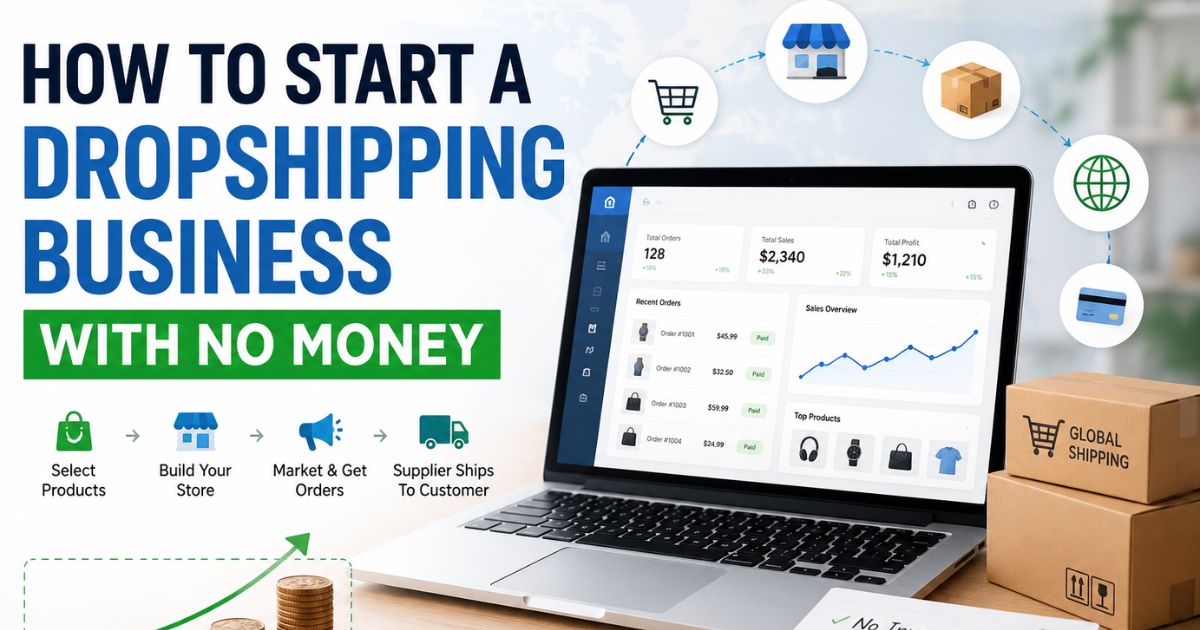

Starting an online store without inventory, warehouses, or thousands in startup capital sounds impossible. It’s not. Dropshipping lets you sell products without buying them first—suppliers ship directly to customers after you make a sale. While “no money” is ambitious, you can realistically launch with under $100 or even free if you’re strategic. This guide walks you through exactly how to build a legitimate dropshipping business when budget is your biggest constraint, including which corners you can cut safely and which ones will cost you later.
Understanding the Real Costs of Dropshipping
The phrase “no money” needs clarification. A dropshipping business has lower barriers than traditional retail, but completely free is misleading.
Absolute minimum costs:
- Domain name: $0-$15/year (some platforms include this free initially)
- E-commerce platform: $0-$29/month (free trials available)
- Marketing: Time investment or $5-$20 for initial testing
- Payment processing: 2-3% per transaction (unavoidable)
What you DON’T need:
- Inventory purchases
- Warehouse rental
- Fulfillment staff
- Bulk product orders
- Retail storefront
The business model works because suppliers hold inventory. You market and sell products, customers pay you, you purchase from the supplier at wholesale price, and they ship directly to your customer. Your profit is the difference between retail and wholesale price.
Can you start with literally zero dollars? Technically yes, using only free trials and platforms. Realistically, expect to invest $50-$150 over your first three months for sustainability.
Choosing Your Niche Without Market Research Tools
Expensive tools like Jungle Scout or Helium 10 aren’t necessary when you’re bootstrapping.
Free niche research methods:
Google Trends shows search interest over time. Compare potential niches to see which have stable or growing demand. Avoid declining trends.
Amazon Best Sellers reveals what people actually buy. Browse categories looking for:
- Products with 100-2,000 reviews (proven demand, not oversaturated)
- Price points between $20-$100 (enough margin, not too expensive)
- Small, lightweight items (lower shipping issues)
Reddit and Facebook Groups expose real problems people discuss. Search communities related to hobbies, lifestyles, or needs. What do people repeatedly ask about or complain they can’t find?
AliExpress Popular Products section shows trending items suppliers are moving. Cross-reference with Google Trends to verify this isn’t a dying fad.
Criteria for a good zero-budget niche:
- Passionate audience (hobbyists spend money)
- Products people need repeatedly or gift
- Not available in every local store
- Solves a specific problem
- Margins above 30%
- Not fragile or extremely heavy
Niches to avoid:
- Electronics (warranty nightmares, high return rates)
- Trademarked products (legal issues)
- Products you can’t ethically stand behind
- Items with liability concerns (baby products, medical devices)
Selecting Free or Low-Cost E-Commerce Platforms
Your storefront doesn’t require Shopify’s $29/month immediately.
Completely free options:
WooCommerce + WordPress.com Free Plan
- Fully functional store
- Limitations: WordPress branding, no custom domain initially, basic features only
- Best for: Testing product-market fit before investing
Ecwid Free Plan
- 10 products maximum
- Sell on social media, existing website, or their instant site
- No transaction fees beyond payment processor
- Best for: Single-product or micro-niche stores
Big Cartel Free Plan
- 5 products maximum
- Simple, clean interface
- Limited customization
- Best for: Absolute beginners testing the model
Low-cost platforms with trials:
Shopify ($1 for first month, then $29/month)
- Industry standard
- Massive app ecosystem
- 14-day free trial (no credit card required)
- Best for: Serious commitment after validation
Wix eCommerce (14-day free trial, then $27/month)
- Drag-and-drop simplicity
- Integrated marketing tools
- Best for: Non-technical founders
Strategy for zero budget: Start with Ecwid or WooCommerce free plan. Once you make your first 10-20 sales, reinvest profits into Shopify for better features and credibility.
Finding Reliable Suppliers With Zero Upfront Costs
Supplier quality determines your reputation. Poor suppliers mean angry customers and refunds.
Free supplier directories:
AliExpress
- Largest selection
- Individual suppliers (quality varies dramatically)
- Check: Order count, ratings above 95%, years in business, communication responsiveness
- Test orders recommended before selling
Oberlo (Free for Shopify users)
- Curated AliExpress products
- Automated order fulfillment
- Real-time inventory sync
- Supplier ratings built-in
Spocket (Free plan available)
- US and EU suppliers (faster shipping than China)
- Higher base costs but better shipping times
- 25 products on free plan
SaleHoo Directory ($67/year, but offers trial)
- Vetted suppliers only
- Reduced scam risk
- Worth investment after first profits
How to vet suppliers without paying for samples:
- Check reviews obsessively – Read negative reviews specifically. What do people complain about?
- Message suppliers directly – Ask about defect rates, average shipping time to your target country, return policies. Professional responses indicate serious businesses.
- Start with one test order to yourself – Yes, this costs $10-30, but shipping a product to your own address before selling reveals actual shipping time, packaging quality, and product accuracy.
- Look for ePacket shipping – Faster than standard shipping from China (10-20 days vs 30-60 days), often free from supplier.
- Verify business documentation – Established suppliers provide business licenses, factory photos, product certifications.
Red flags:
- New suppliers with few orders
- Prices dramatically below competitors (quality issues or scam)
- Poor English communication (delays in resolving customer issues)
- No clear return policy
- Stock photos only (might not actually have product)
Building Your Store for Free
Design impacts conversion rates. Poor design kills sales regardless of products.
Free design resources:
Canva Free – Create logos, banners, social media images, product mockups without design skills.
Unsplash/Pexels – High-quality free stock photos for homepage, about page, blog content.
Google Fonts – Professional typography that loads fast.
ColorHunt – Pre-made color palettes that look professional together.
Essential pages (even on a bootstrap budget):
Homepage – Clear value proposition, featured products, trust signals (even simple ones like “Secure Checkout” badges).
Product pages – Write original descriptions (never copy supplier text). Include dimensions, materials, use cases, who it’s for. Use bullet points for scannability.
About page – Humanize your store. Why do you sell these products? What problem do you solve? Even a bootstrapped store needs personality.
Contact page – Email address minimum. Consider free Google Voice number for text support.
Shipping/Returns policy – Transparency builds trust. If shipping takes 2-3 weeks, say so. Clear return policy reduces disputes.
Free trust-building elements:
- Customer service email that you actually monitor
- Professional (not cute) email address: support@yourdomain.com not coolstuff123@gmail.com
- SSL certificate (included free with most platforms)
- Social media profiles (free to create, post consistently)
- Clear product photos from multiple angles
Conversion optimization without paid tools:
- Product titles that include what it is, key benefit, and primary use
- Prices ending in .95 or .97 (psychologically lower than round numbers)
- Single, clear call-to-action button per page
- Mobile-responsive design (test on your phone before launching)
- Page load speed under 3 seconds (compress images with free tools like TinyPNG)
Marketing Your Dropshipping Business Without Ad Spend
Paid ads accelerate growth but aren’t required to make your first sales.
Organic social media strategies:
Instagram (completely free)
- Post daily: product photos, lifestyle images, customer results, educational content
- Use 20-30 relevant hashtags (mix of popular and niche-specific)
- Engage genuinely: comment on posts in your niche, respond to every comment/DM
- Stories with polls, questions, behind-the-scenes content
- Partner with micro-influencers (under 10K followers) who might post for free product
TikTok (highest organic reach currently)
- Short videos showing product in use, unboxing, problem-solving
- Trending sounds increase visibility
- Authenticity outperforms polish
- Post 1-3 times daily for algorithm favor
- Duets and stitches with relevant content
Pinterest (underrated for products)
- Create pins for each product linking to your store
- Rich pins show real-time pricing
- DIY content, how-to guides, inspiration boards related to your niche
- Longevity: pins get discovered months after posting
Facebook Groups (relationship-based selling)
- Join groups related to your niche (NOT to spam)
- Provide genuine value: answer questions, share expertise
- Once established, mention your store when contextually relevant
- Create your own group around the lifestyle/interest, not just products
Content marketing (time investment, zero dollars):
Blog posts on your store
- “How to choose [your product type]”
- “10 ways to use [your product]”
- “[Problem] solutions for [target customer]”
- Targets long-tail keywords, builds topical authority
- Drives organic Google traffic over time
YouTube product reviews and tutorials
- Film with smartphone
- Simple editing with free software (DaVinci Resolve, iMovie)
- Product demonstrations, comparisons, unboxings
- Include store link in description
Answer questions on Quora and Reddit
- Find questions related to problems your products solve
- Provide thorough, helpful answers
- Mention your product naturally if genuinely relevant
- One quality answer can drive sales for months
Email marketing (free up to threshold):
Mailchimp – Free up to 500 subscribers
MailerLite – Free up to 1,000 subscribers
Collect emails with:
- 10% discount for newsletter signup
- Free guide related to your niche
- Early access to new products
Send weekly: tips, new arrivals, customer stories, exclusive discounts.
Guerrilla tactics:
- Create valuable free resources (size guides, comparison charts, checklists) that require email to download
- Host Instagram Live sessions answering questions about your niche
- Collaborate with complementary non-competing stores for cross-promotion
- Create Pinterest boards solving problems related to your niche
- Post in local community boards if products have local appeal
Managing Cash Flow With Zero Capital
The dropshipping model’s biggest advantage is you get paid before paying suppliers.
Payment processing reality:
Most payment processors (Stripe, PayPal) hold funds initially for new stores:
- PayPal: Often 21-day rolling reserve for new accounts
- Stripe: 7-14 day rolling reserve initially
This creates a cash flow gap. You need to fulfill orders before receiving the money.
Solutions:
PayPal Credit or Affirm – Small credit lines for new businesses (use responsibly, only for confirmed orders).
Family/friend micro-loan – Borrow $100-200 specifically for order fulfillment, pay back after holds release.
Start with COD (Cash on Delivery) markets – Some countries allow customer payment on delivery, eliminating your cash flow gap.
Longer shipping windows – 14-21 day delivery timeframe gives payment processors time to release funds before you must pay supplier.
Manual fulfillment initially – Don’t automate. Wait until customer payment clears, then order from supplier. Slower, but eliminates cash flow risk.
Price strategically:
Calculate backward from desired profit:
- Supplier cost: $10
- Shipping: $3
- Payment processing (3%): Calculate based on final price
- Your target profit: $10
- Selling price: $33.50 (includes processing fee)
Build in 10-15% buffer for refunds, returns, and unexpected costs.
Handling Customer Service Like a Professional Operation
Your responsiveness determines repeat customers and reviews.
Free customer service tools:
Gmail – Create professional support@yourdomain.com address
Forwarding to personal email – Never miss messages
Canned responses – Pre-write answers to common questions
Google Voice – Free phone number for US-based businesses
Expected response times:
- Email: Within 24 hours
- Social media DMs: Within 6 hours
- Live chat (if you add it later): Within 5 minutes during business hours
Common customer service scenarios:
“Where is my order?”
- Provide tracking immediately (automate with your platform if possible)
- If no tracking, contact supplier for update
- Offer small discount on next order for delays beyond quoted timeframe
“This isn’t what I ordered”
- Apologize immediately
- Ask for photo proof
- Contact supplier (they may have shipped wrong item)
- Offer full refund or replacement
- Never blame the supplier to the customer
“I want a refund”
- Process quickly without argument (fighting costs more in time and reputation)
- Understand why: collect feedback to prevent future issues
- If product defect, work with supplier for reimbursement
“This is taking too long”
- Set expectations upfront (put shipping times clearly on product pages)
- If within quoted timeframe, politely remind them
- If delayed, proactively reach out before they complain
- Offer partial refund for significant delays
Building systems with no budget:
- Create FAQ document for yourself with answers to every question you receive
- Spreadsheet tracking every order, status, customer communication
- Calendar reminders to follow up on delayed shipments
- Templates for common email responses (personalize before sending)
Legal and Administrative Basics on a Bootstrap Budget
Ignoring legal requirements creates expensive problems later.
Business structure:
Sole proprietorship – Default if you do nothing. Simplest, but no liability protection. Free to start.
LLC – Separates personal and business liability. Costs vary by state ($50-$500). Worth it once you’re making consistent sales.
Start as sole proprietor, form LLC after validating your business (usually after $5,000 in revenue).
Free/low-cost business registration:
- Register business name with your county clerk ($10-50)
- Apply for EIN (free from IRS website, takes 10 minutes)
- Check local business license requirements (varies widely)
Tax obligations:
- Sales tax: Required if you have nexus (business presence) in a state. Most platforms can auto-calculate.
- Income tax: Set aside 25-30% of profit for taxes
- Quarterly estimated payments if earning over ~$1,000/year profit
Free accounting tools:
- Wave Accounting (completely free for basic bookkeeping)
- Spreadsheet tracking every expense and sale
- Separate bank account for business (many banks offer free business checking)
Terms and Privacy Policy:
Use free generators (Termly, Shopify’s generator) as starting templates. Have a lawyer review eventually, but free templates prevent the most common issues.
Trademark considerations:
Before naming your business, search:
- USPTO.gov trademark database (free)
- Google the exact name
- Social media handles
Don’t invest in a name you can’t protect.
Scaling From First Sale to Consistent Revenue
Your first sale validates the model. Consistent revenue requires systems.
Reinvestment priority order:
- Customer acquisition that worked – If TikTok videos drove your first sales, double down there before trying new channels.
- Paid platform – Move from free trial to paid Shopify/Wix for better features and credibility.
- Custom domain – yourstore.com instead of yourstore.platformname.com. $10-15/year dramatically improves trust.
- Sample products – Order best-sellers to yourself for better photos, detailed descriptions, quality verification.
- Paid advertising – Start with $5/day Facebook or TikTok ads testing what already sold organically.
- Email marketing – Once you have 100+ subscribers, invest in better email platform features.
- LLC formation – Protect yourself legally once revenue is consistent.
Metrics to track (free with Google Analytics):
- Traffic sources (which marketing efforts actually work)
- Conversion rate (visitors who buy)
- Average order value
- Customer acquisition cost
- Return rate by product
When to quit your job:
Don’t. Not immediately. Dropshipping income is volatile initially.
Safe transition point:
- 6 months consecutive profit
- Monthly income exceeding 75% of your current salary
- 3-6 months expenses saved
- Systems that don’t require 40+ hours/week
Many successful dropshippers run their business part-time indefinitely.
Common Mistakes That Waste Your Limited Resources
Choosing products based on personal preference instead of market demand
What you love doesn’t matter. What people search for and buy matters. Validate every product idea with search volume and competitor sales data.
Copying successful stores exactly
Competitors with $100K ad budgets can outspend you. Find underserved sub-niches within their market instead of direct competition.
Ignoring shipping times
Two-day Amazon Prime trained customers to expect fast delivery. If your products take three weeks, this must be crystal clear before purchase. Surprise delays create refunds and bad reviews.
No margin calculation
Many beginners sell at 20% margin thinking volume compensates. Returns, refunds, platform fees, and ad costs eat this completely. Minimum 40% margin for sustainability.
Automating before validating
Apps that auto-fulfill orders are convenient but add cost. Manually process your first 50-100 orders to understand customer issues, supplier reliability, and actual fulfillment time.
Spending on unnecessary tools
Every app costs money. The $9 countdown timer app, $15 review app, $29 upsell app adds up to $50+/month. Use free alternatives until revenue justifies premium tools.
Generic product descriptions
Copying supplier descriptions means identical content to hundreds of other stores. Google won’t rank you, and customers can’t differentiate you. Write original descriptions for every product.
No email collection
Relying only on social media means you don’t own your audience. Platforms change algorithms, accounts get banned. Email lists you control forever.
Giving up after two weeks
Dropshipping isn’t passive income. First sales often take 30-90 days of consistent effort. Most people quit before their marketing gains traction.
Realistic Expectations and Timeline
The “make $10K your first month” claims are survivorship bias. Here’s what actually happens for most people:
Month 1:
- Setting up store, finding suppliers, creating content
- 0-5 sales if you’re executing well
- Revenue: $0-$150
- Profit: Usually negative after platform costs
Month 2:
- Marketing content starts getting traction
- Learning what messaging resonates
- 10-30 sales
- Revenue: $300-$800
- Profit: $50-$200
Month 3:
- Consistent posting, improving based on data
- Finding winning products within your niche
- 30-100 sales
- Revenue: $800-$2,500
- Profit: $200-$700
Month 6:
- Established presence, repeat customers
- 100-300 sales
- Revenue: $3,000-$10,000
- Profit: $1,000-$3,000
These are realistic ranges for someone working 10-15 hours/week with zero budget.
Some hit these numbers faster. Many take longer. Variables include niche selection, marketing skill, consistency, and timing.
Advanced Strategies Once You’ve Made First Sales
Create product bundles
Customers who bought item A often need item B. Bundle them at slight discount. Increases average order value without additional marketing cost.
Implement upsells and cross-sells
“Customers also bought…” sections drive 10-30% additional revenue. Most platforms include this feature free.
Develop brand identity
Generic dropshipping stores struggle long-term. Create a brand with:
- Consistent visual style
- Clear mission/values
- Unique voice in all communications
- Custom packaging (add this once profitable)
Build loyalty programs
Free apps like Smile.io offer basic plans. Points for purchases, referrals, social shares. Increases repeat purchase rate 20-40%.
Expand to multiple channels
Don’t rely only on your website. Sell also on:
- Amazon (FBA not required for dropshipping)
- eBay
- Facebook Marketplace
- Etsy (if products fit)
Create information products
If you’ve built expertise in your niche, create guides, courses, or consultations. Higher margins than physical products.
Transition to hybrid model
Order winning products in bulk (100+ units) directly from manufacturers. Lower per-unit cost, faster shipping, higher margins. Requires capital but maximizes profit on proven sellers.
Essential Tools That Stay Free Forever
Canva Free – Design (forever free tier)
Google Analytics – Traffic analysis (completely free)
Google Search Console – SEO monitoring (completely free)
Mailchimp or MailerLite – Email marketing (free up to subscriber threshold)
Answer the Public – Keyword research (limited free searches)
Google Trends – Trend analysis (completely free)
Wave Accounting – Bookkeeping (free with optional paid features)
Trello or Notion – Project management (robust free plans)
GIMP – Image editing (free, open-source Photoshop alternative)
Buffer Free – Social media scheduling (limited posts per month)
Loom – Video messaging for customer support (free tier available)
When to Invest Money Into Your Business
Free tools get you started. Strategic investment accelerates growth.
Worth paying for early:
- Domain name ($10-15/year) – Immediate credibility boost
- One test order per product ($10-30) – Prevents disasters
- Paid platform after validation ($29/month) – Better features convert better
Worth paying for after first $1,000 revenue:
- LLC formation ($50-300) – Legal protection
- Professional product photos ($100-500 or DIY with better camera) – Higher conversion rates
- Paid advertising ($100-300 initial testing) – Scales what’s working
- Premium email platform ($15-50/month) – Better automation
Worth paying for after $5,000 revenue:
- Professional logo design ($100-500) – Brand differentiation
- Bulk inventory of winners (varies) – Better margins and shipping
- Virtual assistant ($3-8/hour internationally) – Free your time for strategy
- Premium apps and tools ($50-100/month) – Efficiency improvements
Never worth paying for:
- “Dropshipping courses” promising secrets (information is freely available)
- Automated stores (generic, poor quality)
- Sketchy “guaranteed traffic” services (usually bots)
- Overpriced “business coaching” before you have a business
FAQ
Can I really start dropshipping with absolutely zero money?
Technically yes, using free trials and platforms. Realistically, budget $50-100 for sustainability. You’ll need a domain eventually, test product orders, and likely small advertising tests. The business model requires minimal money compared to traditional retail, but “zero” means using only free trials temporarily.
How long until I make my first sale?
Most people see first sales within 30-60 days of consistent marketing effort. Factors include niche competitiveness, marketing quality, and product selection. If you’ve had zero sales after 90 days, reassess your product-market fit and marketing channels.
Do I need to pay taxes on dropshipping income?
Yes. All business income is taxable. You’ll owe income tax on profit (revenue minus expenses) and potentially sales tax depending on your location and where customers are located. Set aside 25-30% of profit for taxes.
What if customers want refunds?
Issue them promptly. Fighting refunds costs more in time, stress, and reputation than the product cost. Build refunds into your pricing (expect 2-10% depending on niche). Work with suppliers to get reimbursed for defective products.
Can I dropship branded products like Nike or Apple?
No. Selling trademarked products without authorization violates intellectual property law and will get your store shut down. Stick to generic products or work with suppliers who have proper licensing.
How do I compete with Amazon?
Don’t compete on price or speed. Compete on:
- Specialized niche expertise
- Curated selection for specific audiences
- Superior customer service
- Brand personality
- Community building
Amazon is a general marketplace. You’re a specialized expert in your niche.
Is dropshipping saturated?
Popular niches are competitive. But new products, trends, and sub-niches emerge constantly. Success comes from finding underserved audiences, not competing in oversaturated markets. If your approach is “sell generic items everyone else sells,” you’ll struggle. If you solve specific problems for specific people, opportunities exist.
Do I need business experience to start?
No. Dropshipping is simpler than most business models. Skills you’ll need to learn: basic marketing, customer service, simple accounting. All learnable free online. Your lack of experience can be an advantage—you approach problems without preconceived limitations.
What’s the difference between dropshipping and affiliate marketing?
Affiliate marketing: You promote someone else’s products, earn commission (5-30% typically), have no customer relationship or control.
Dropshipping: You own the store, control pricing, own customer relationship, handle service, earn full margin (typically 30-60%), build a brand asset.
Dropshipping requires more effort but builds more valuable long-term business.
Should I focus on one product or multiple products?
Start with 5-15 related products within one niche. Too few limits revenue potential. Too many splits marketing focus and complicates messaging. After finding winners, you can expand to more products or focus entirely on best-sellers.
How do I know if a supplier is legitimate?
Check: Years in business (2+ years preferred), order volume (thousands of orders), rating (95%+ positive), communication responsiveness (replies within 24 hours), willingness to provide documentation, and always order test products yourself before selling.
Can I do this part-time?
Yes. Most successful dropshippers started part-time. Expect to invest 10-20 hours weekly for meaningful progress. More time accelerates results, but consistency matters more than hours logged.
Conclusion
Starting a dropshipping business with no money isn’t effortless, but it’s achievable. The model’s core advantage—getting paid before buying inventory—solves traditional retail’s biggest barrier. Your constraints force creativity: better organic marketing, stronger customer relationships, and careful product selection instead of throwing money at problems.
Begin with free platforms and tools. Validate demand before investing. Focus relentlessly on solving specific problems for specific people rather than being a generic online store. Expect 60-90 days before meaningful traction. Reinvest early profits strategically.
The businesses that survive aren’t those with the biggest starting budgets. They’re the ones that provide genuine value, communicate honestly, and persistently improve based on real customer feedback. Your empty bank account doesn’t prevent any of those things.
Start today with what you have. Research niches for two hours. Set up a free store tomorrow. Source five products by week’s end. Create content daily. Respond to every message. Learn from every customer. Your first sale won’t make you rich, but it proves the model works. Your hundredth sale funds your LLC. Your thousandth sale might replace your income.
The question isn’t whether you can start with no money. It’s whether you’ll commit the time and learning required to build something sustainable. Money accelerates growth—it doesn’t create it. Your effort, consistency, and willingness to adapt determine success far more than your starting budget.