
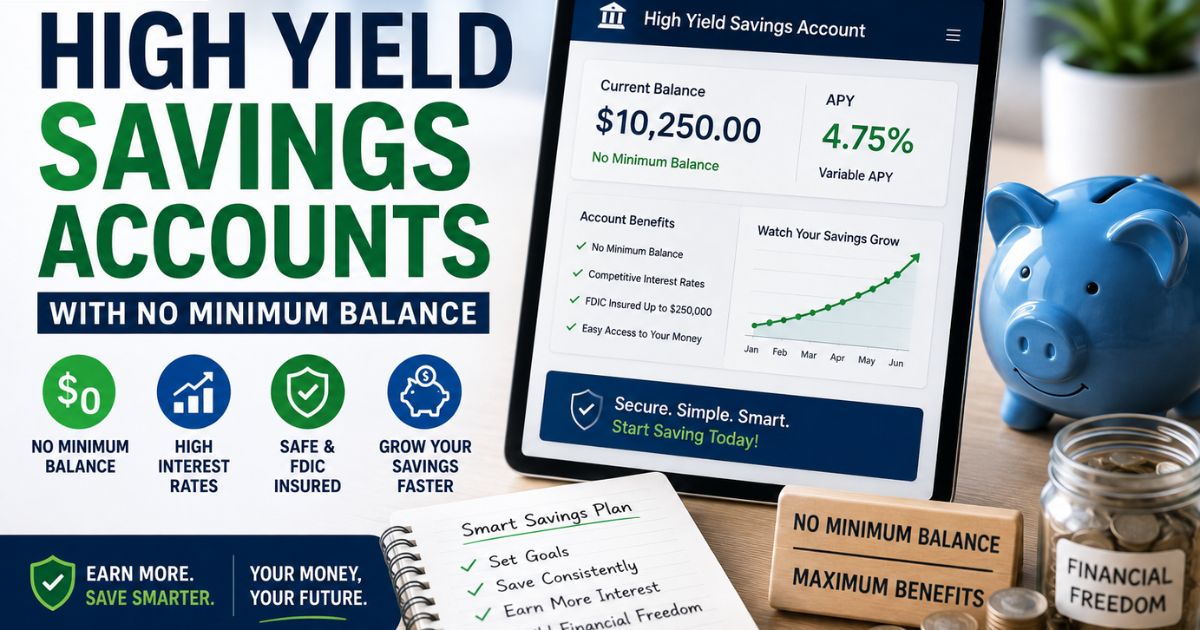

Finding a savings account that pays competitive interest without requiring you to maintain thousands of dollars can feel impossible. Traditional banks often lock their best rates behind minimum balance requirements that put them out of reach for everyday savers. The good news? A growing number of online banks and credit unions now offer high yield savings accounts with absolutely no minimum balance—meaning you can open an account with $1 and still earn the same competitive APY as someone depositing $100,000. This guide breaks down the best options available, what makes them worth considering, and how to choose the account that fits your financial situation.
What Makes a High Yield Savings Account Worth Your Time
The difference between a traditional bank savings account and a high yield account isn’t subtle. While major brick-and-mortar banks typically offer around 0.01% APY, high yield savings accounts regularly provide rates 40 to 50 times higher.
That gap translates to real money. On a $10,000 balance, a traditional savings account might earn you $1 per year. The same balance in a high yield account earning 4.00% APY generates $400 annually—enough to cover several months of streaming subscriptions, a few grocery trips, or a decent chunk of an emergency fund goal.
High yield accounts work exactly like regular savings accounts. Your money remains FDIC insured up to $250,000 per depositor, per institution. You can withdraw funds when needed (though federal regulations previously limited certain transactions to six per month, that rule was suspended in 2020 and hasn’t been reinstated). The main difference is simply that your money grows faster.
Top High Yield Savings Accounts With No Minimum Balance
Marcus by Goldman Sachs
Marcus consistently ranks among the most popular online savings options for good reason. They require no minimum deposit to open and no minimum balance to maintain your account.
Current APY: Rates fluctuate with the federal funds rate but remain competitive within the online banking space.
Key features:
- Zero monthly maintenance fees
- No transaction fees for standard transfers
- Easy linking to external bank accounts
- FDIC insured through Goldman Sachs Bank USA
- User-friendly mobile app with biometric login
Marcus doesn’t charge penalty fees if your balance drops to zero, which makes it particularly useful for people building their first emergency fund. You can start with whatever amount you have available and add to it gradually.
The platform offers straightforward account management without complicated tier systems or promotional rate games. What you see is what you get—a refreshing approach in an industry that often buries important details in fine print.
Ally Bank
Ally has built its reputation on customer service and transparency. Their savings account requires no minimum balance to open or maintain, and they’ve never charged monthly maintenance fees.
Current APY: Competitive rates that adjust with market conditions.
Key features:
- 24/7 customer service with actual humans
- No overdraft fees (savings accounts don’t typically have these, but Ally’s checking accounts don’t either)
- Savings buckets feature that lets you organize money toward different goals within one account
- FDIC insured
- Integrated budgeting tools
The savings buckets feature deserves special mention. Instead of opening multiple accounts for different goals, you can create virtual “buckets” within your main savings account—one for vacation, another for car repairs, a third for holiday gifts. Each bucket shows its own balance and progress toward your target amount.
Ally’s mobile app receives consistently high ratings for usability. Depositing checks, transferring money, and tracking your savings growth all happen within a clean, intuitive interface.
American Express Personal Savings
Yes, the credit card company also offers a high yield savings account. It requires no minimum balance and charges no monthly fees.
Current APY: Historically among the highest rates available.
Key features:
- No minimum deposit to open
- No monthly maintenance fees
- No transaction fees
- FDIC insured through American Express National Bank
- Clean, simple account structure
American Express takes a minimalist approach to their savings account. There are no checking accounts, no debit cards, no complicated product suites. Just a straightforward savings account that pays competitive interest.
This simplicity appeals to people who want to park money somewhere it’ll grow without dealing with additional banking relationships. You can link your existing checking account from another bank and transfer money back and forth as needed.
The application process takes about five minutes. Once approved, you can typically start transferring money the same day.
Discover Online Savings Account
Discover brings the same customer service reputation from their credit card business to their banking products. No minimum balance required, no monthly fees charged.
Current APY: Consistently competitive with other top online savings accounts.
Key features:
- No minimum to open or maintain
- No monthly fees of any kind
- 24/7 U.S.-based customer service
- FDIC insured
- Optional ATM access through a money market account
Discover’s customer service consistently earns high marks. When you call, you reach someone quickly, and that person typically has the authority to solve your problem without transferring you multiple times.
The platform also offers a checking account and money market account if you want to consolidate more of your banking in one place. But the savings account works perfectly fine as a standalone product.
UFB Direct
UFB Direct (formerly Ultimate Federal Bank) focuses exclusively on high yield savings products. No minimums, no fees, competitive rates.
Current APY: Often among the highest available.
Key features:
- No minimum balance requirement
- No monthly maintenance fees
- Mobile check deposit
- FDIC insured through Axos Bank
- Simple account structure
UFB Direct operates with less brand recognition than Marcus or Ally, but that doesn’t make them less legitimate. They’re a division of Axos Bank, which has operated since 2000.
The lower brand recognition sometimes works in your favor—smaller institutions occasionally offer slightly higher rates to attract deposits. UFB’s rates frequently land at the top of comparison charts.
Their mobile app lacks some of the polish found with larger competitors, but it handles the essential functions: checking your balance, transferring money, depositing checks.
CIT Bank Platinum Savings
CIT Bank offers two savings products: Platinum Savings and Savings Connect. The Platinum Savings account requires no minimum balance, though you’ll need at least $100 to open it initially.
Current APY: Competitive rates with no balance tiers.
Key features:
- No minimum balance to maintain (though $100 to open)
- No monthly fees
- Industry-leading rates during promotional periods
- FDIC insured
- Savings pods feature for goal tracking
Once you deposit that initial $100, your balance can drop to zero without penalty. The account doesn’t charge monthly fees regardless of your balance.
CIT’s savings pods work similarly to Ally’s buckets, letting you mentally allocate money toward specific goals while keeping it in one account that earns the full APY.
How APY Actually Works
APY stands for Annual Percentage Yield. It tells you how much your money will grow over one year, including compound interest.
Compound interest means you earn interest on your interest. Here’s a simple example:
You deposit $5,000 into an account earning 4.00% APY. After one month, you’ve earned about $16.67 in interest. That brings your balance to $5,016.67.
The next month, you earn interest on $5,016.67—not just your original $5,000. Month by month, the growth accelerates slightly because your balance keeps increasing.
Most high yield savings accounts compound daily, which means your interest gets calculated and added to your balance every single day. This maximizes your earnings compared to accounts that compound monthly or quarterly.
APY differs from APR (Annual Percentage Rate). APR doesn’t account for compounding, so it shows a lower number. Banks must disclose APY on deposit accounts, which gives you an accurate picture of what you’ll actually earn.
Why Online Banks Can Offer Higher Rates
The rate difference between traditional banks and online banks isn’t random. It comes down to operating costs.
Physical bank branches are expensive. Banks need to pay for:
- Real estate in prime locations
- Building maintenance and utilities
- Tellers, managers, and branch staff
- Security systems
- Furnishings and equipment
A single branch can cost hundreds of thousands of dollars annually to operate. Banks with thousands of branches carry enormous overhead expenses.
Online banks eliminate most of these costs. They operate primarily through websites and mobile apps. Customer service happens via phone, chat, or email rather than face-to-face. Without the burden of maintaining physical locations, they can pass the savings on to customers through higher interest rates and lower fees.
This doesn’t make online banks less safe. They carry the same FDIC insurance as traditional banks, protecting your deposits up to $250,000 per account holder, per institution. If the bank fails, the government guarantees your money.
The trade-off is convenience. You can’t walk into a branch to deposit cash or speak with someone in person. For people who rarely visit bank branches anyway, that’s not much of a sacrifice.
What to Look for Beyond the Interest Rate
APY matters, but it’s not the only consideration when choosing a savings account.
Fee Structure
The best accounts charge zero monthly maintenance fees regardless of your balance. Some banks advertise high rates but then charge $5 or $10 monthly unless you maintain a minimum balance. A $5 monthly fee costs you $60 per year—which could wipe out your interest earnings if you’re starting with a small balance.
Read the fee schedule carefully. Look for:
- Monthly maintenance fees
- Transfer fees
- Wire transfer fees
- Insufficient funds fees
- Account closing fees
The accounts listed in this guide charge none of these fees under normal usage.
Access to Your Money
Savings accounts aren’t designed for daily spending, but you should be able to access your money when you need it.
Check how long transfers take. Most accounts can transfer money to your external checking account in 1-3 business days. Some offer expedited transfers for a fee.
Ask whether the bank offers ATM access. Most pure savings accounts don’t include ATM cards, but some banks offer paired checking accounts or money market accounts with debit cards if you want that option.
Verify whether you can deposit checks through mobile app. This feature has become standard but isn’t universal. Without it, you’ll need to transfer money in from another bank rather than depositing directly.
Customer Service Quality
When you have a question about your account, you want answers quickly from knowledgeable people.
Look for:
- 24/7 availability (or at least extended hours)
- Phone, chat, and email options
- Average wait times
- Customer service ratings from independent sources
The difference becomes obvious when you face an issue. Banks with strong customer service resolve problems in one conversation. Banks with weak customer service bounce you between departments, put you on hold repeatedly, and sometimes fail to fix the issue at all.
Mobile App Functionality
If you’re comfortable with technology, you’ll probably manage your account primarily through a mobile app.
Essential features include:
- Balance checking
- Transaction history
- Mobile check deposit
- Transfers to external accounts
- Fingerprint or face recognition login
- Push notifications for large transactions
Optional but nice features include:
- Savings goal tracking
- Spending insights
- Budget tools
- Financial education content
Download the app and read recent reviews before opening an account. An app with a 2-star rating and complaints about crashes or login problems will frustrate you every time you use it.
Bank Stability and Reputation
FDIC insurance protects your money even if a bank fails, but bank failures still create headaches. Your funds might be inaccessible for several days while regulators sort things out.
Research the bank’s history:
- How long have they operated?
- Who owns them?
- Have they faced regulatory issues?
- What do customer reviews say about their reliability?
Established online banks like Ally, Marcus, and American Express have track records you can evaluate. Newer institutions might offer slightly higher rates to attract customers, but they come with less certainty about their long-term stability.
Common Mistakes People Make With High Yield Savings Accounts
Chasing Rate Changes Too Aggressively
Interest rates fluctuate. One bank might offer 4.25% APY this month while another offers 4.20%. Next month, those positions might reverse.
Some people constantly move their money to whichever bank currently advertises the highest rate. This wastes time for minimal gain.
On a $10,000 balance, the difference between 4.20% and 4.25% equals about $5 per year. Moving your money requires:
- Opening a new account
- Verifying your identity
- Linking external accounts
- Initiating transfers
- Waiting for transfers to complete
- Closing your old account
That process takes hours for a $5 annual difference.
Choose a bank with consistently competitive rates and solid features, then leave your money there unless rates diverge significantly (think 0.50% or more).
Leaving Too Much Money in Savings
High yield savings accounts work beautifully for emergency funds and short-term savings goals. They don’t work well for long-term wealth building.
Over long time periods, savings account interest typically doesn’t keep pace with inflation. Even at 4.00% APY, you’re barely maintaining purchasing power when inflation runs at 3-4%.
Money you won’t need for five, ten, or twenty years belongs in investment accounts—401(k)s, IRAs, brokerage accounts with diversified portfolios. These carry more short-term volatility but historically generate much higher long-term returns.
A reasonable approach:
- Keep 3-6 months of expenses in a high yield savings account (emergency fund)
- Save for specific goals happening within 1-3 years in a high yield savings account
- Invest everything else for long-term growth
Ignoring Credit Union Options
This guide focuses on nationally available online banks, but don’t overlook credit unions. Many offer excellent savings rates with no minimum balance requirements.
Credit unions are non-profit cooperatives owned by their members. Without shareholders demanding profits, they often return earnings to members through better rates and lower fees.
The catch is membership requirements. Some credit unions only serve specific employers, geographic areas, or professional groups. Others allow anyone to join by making a small donation to an affiliated nonprofit.
Check credit unions in your area or industry. You might find rates matching or exceeding the best online banks.
Not Having a Savings Strategy
Opening a high yield savings account feels productive, but the account itself doesn’t create financial security. Regular deposits do.
Before opening an account, define your savings goals:
- How much do you need for a fully funded emergency fund?
- What other short-term goals are you saving toward?
- How much can you realistically save each month?
Set up automatic transfers from your checking account to your savings account. Even $50 or $100 per month adds up significantly over time, especially with compound interest working in your favor.
Automating the process removes willpower from the equation. The money moves to savings before you can spend it on something else.
How to Open a High Yield Savings Account
The process takes about 10-15 minutes for most online banks.
Step 1: Gather required information
You’ll need:
- Social Security number or Tax ID
- Driver’s license or state ID
- Current address
- Date of birth
- Email address and phone number
- Employment information (sometimes)
Step 2: Choose your bank and start the application
Visit the bank’s website or download their mobile app. Look for “Open an Account” or similar language.
Step 3: Provide personal information
Enter your basic details. The bank uses this information to verify your identity and check consumer reporting databases.
Step 4: Fund your account
Most banks let you link an external checking account and transfer money electronically. Some accept checks or wire transfers.
Remember that accounts advertising “no minimum balance” might still require a small initial deposit to open—typically $1 to $100. After that opening deposit, your balance can drop to zero without penalty.
Step 5: Verify your identity
Banks might ask security questions based on your credit history, or they might send verification codes to your phone or email.
Step 6: Wait for approval
Most applications receive instant approval. Some require 1-2 business days for review, particularly if the automated identity verification doesn’t find a clear match.
Step 7: Set up account access
Create your username and password. Download the mobile app if you haven’t already. Set up fingerprint or face recognition login if available.
Step 8: Configure alerts and settings
Turn on notifications for:
- Large transactions
- Low balance warnings (if you want them)
- Monthly statements
Link your external checking account for easy transfers back and forth.
Maximizing Your Savings Account Earnings
Take Advantage of Sign-Up Bonuses Carefully
Some banks offer cash bonuses for opening new accounts—typically $100 to $300 if you deposit a certain amount and keep it there for a specified period.
These bonuses can provide a nice boost, but read the terms closely:
- What’s the minimum deposit required?
- How long must you maintain that balance?
- When does the bonus get paid?
- Are there monthly fees that could offset the bonus?
Calculate whether the bonus actually benefits you. A $200 bonus might sound great, but if it requires maintaining a $25,000 balance for six months in an account earning 0.50% APY when you could earn 4.00% APY elsewhere, you’re losing money.
Example math:
- $25,000 at 0.50% APY for 6 months = $62.50 interest + $200 bonus = $262.50 total
- $25,000 at 4.00% APY for 6 months = $500 interest + $0 bonus = $500 total
The no-bonus option earns nearly twice as much.
Bonuses make sense when they don’t require you to accept a lower rate or maintain a higher balance than you normally would.
Link Multiple Goals to One Account
Many of the banks mentioned offer goal-tracking features—Ally’s buckets, CIT’s pods, or similar tools.
These features let you allocate money mentally without actually splitting it into separate accounts. Why does this matter?
Having one account with $5,000 is better than having five accounts with $1,000 each because:
- Fewer accounts to monitor
- Simplified tax reporting (one 1099-INT instead of five)
- Easier to see your total savings picture
- Same interest rate on the full balance
Set up buckets or pods for:
- Emergency fund
- Car repairs
- Annual insurance premiums
- Holiday gifts
- Vacation
- Home down payment
- Whatever goals matter to you
You’ll see your progress toward each goal while your money earns interest as a unified balance.
Review Rates Quarterly
You don’t need to obsessively check rates weekly, but a quarterly review makes sense.
Set a calendar reminder for every three months. Spend 15 minutes checking whether:
- Your current bank’s rate remains competitive
- Any major rate changes have occurred across the industry
- Your account terms have changed (banks must notify you, but notices sometimes get missed)
If your bank’s rate has dropped significantly below competitors and stayed there for several months, consider switching. If rates remain within 0.25% of top offerings, the hassle of switching probably isn’t worth it.
Understand the Tax Implications
Interest earned in savings accounts is taxable as ordinary income. Your bank will send you Form 1099-INT after the end of each year if you earned more than $10 in interest.
This doesn’t mean savings accounts are bad. It means you should:
- Report the interest on your tax return
- Factor the tax into your effective return
- Consider whether tax-advantaged alternatives make sense for some of your money
If you’re in the 22% tax bracket and earn 4.00% APY, your after-tax return is about 3.12%. Still much better than traditional savings accounts, but worth understanding.
For money you’re definitely saving long-term, tax-advantaged retirement accounts often make more sense than taxable savings accounts.
High Yield Savings vs. Other Options
Money Market Accounts
Money market accounts blend features of savings and checking accounts. They typically offer:
- Interest rates similar to savings accounts
- Check-writing privileges (limited)
- Debit card access
- FDIC insurance
The main advantage is easier access to your money. The main disadvantage is that the best money market rates often require higher minimum balances than the best savings account rates.
Money market accounts make sense if you want ATM access to your emergency fund or prefer having a debit card for occasional large purchases.
Certificates of Deposit (CDs)
CDs lock your money up for a specific term—anywhere from three months to five years—in exchange for a guaranteed interest rate.
Advantages:
- Rates are locked in regardless of market changes
- Rates sometimes exceed savings account rates, especially for longer terms
- FDIC insured
Disadvantages:
- Your money is inaccessible without paying early withdrawal penalties
- You can’t add to the balance after opening
- If rates rise, you’re stuck with your lower rate
CDs work well for money you know you won’t need until a specific date—a home down payment you’re planning to use in exactly 18 months, for example.
They work poorly as emergency funds because emergencies don’t wait for your CD to mature.
Treasury Bills
Treasury bills (T-bills) are short-term government securities with terms of 4, 8, 13, 26, or 52 weeks. They’re sold at a discount and mature at face value, with the difference representing your interest.
Advantages:
- Backed by the U.S. government (even safer than FDIC insurance theoretically)
- Interest is exempt from state and local taxes
- Rates often competitive with or better than savings accounts
Disadvantages:
- Money is locked up until maturity
- Buying and selling requires more steps than transferring money to a savings account
- Minimum purchase of $100
T-bills make sense for money you won’t need for a few months and want to keep extremely safe. They’re less convenient than savings accounts for emergency funds you might need to access quickly.
Regular Checking Accounts
Some checking accounts now offer interest, though rates typically lag behind dedicated savings accounts.
The advantage of keeping money in an interest-bearing checking account is immediate access without transfers. The disadvantage is earning less interest and sometimes facing monthly fees or minimum balance requirements.
A combined approach works well: keep one month of expenses in checking for daily spending, keep 3-6 months of expenses in a high yield savings account for emergencies.
Frequently Asked Questions
Can I really open an account with no money?
Most banks advertising “no minimum balance” still require a small initial deposit to open the account—usually $1 to $100. After that opening deposit, your balance can drop to zero without penalty or fees. A few banks let you open the account with $0 and fund it later, but this is less common.
How often do interest rates change?
Savings account rates aren’t fixed. Banks adjust them based on the federal funds rate and competitive pressure. During periods when the Federal Reserve is actively raising or lowering rates, your savings account rate might change monthly. During stable periods, rates might hold steady for months.
Is my money actually safe with an online bank?
Yes, assuming the bank carries FDIC insurance. This insurance guarantees your deposits up to $250,000 per depositor, per institution, per ownership category. Online banks carry the same insurance as traditional banks. If the bank fails, the government ensures you get your money back.
How long does it take to access my money?
Standard ACH transfers between your savings account and an external checking account typically take 1-3 business days. Some banks offer expedited transfers for a fee. Once the money reaches your checking account, you can spend it immediately via debit card, check, or cash withdrawal.
Can I have multiple high yield savings accounts?
Absolutely. Some people open accounts at different banks to stay under FDIC insurance limits, take advantage of multiple sign-up bonuses, or organize different savings goals. Just be aware that managing multiple accounts requires more time and you’ll receive multiple 1099-INT forms at tax time.
What happens if I need to withdraw money frequently?
Federal Regulation D previously limited certain withdrawals and transfers from savings accounts to six per month. This regulation was suspended in 2020 and hasn’t been reinstated. However, some banks still maintain six-transaction limits in their account agreements, so verify your specific bank’s policy. Excessive withdrawals might also signal to the bank that you’re using a savings account for checking account purposes, which could trigger account closure.
Do these accounts have fees if I close them?
The accounts mentioned in this guide don’t charge early closure fees, but always verify the fee schedule for your specific account. Some banks charge a fee if you close an account within 90 or 180 days of opening, particularly if you received a sign-up bonus.
Why do rates vary so much between banks?
Banks set rates based on how badly they need deposits. A bank with plenty of cash on hand might offer lower rates because they’re not trying to attract new deposits. A bank actively growing its loan portfolio needs more deposits to fund those loans, so they offer higher rates to attract savers. Online banks consistently offer higher rates because they have lower operating costs than traditional banks.
Can I open a joint account?
Most of the banks mentioned offer joint account options. Joint accounts work well for couples managing household finances together or parents helping young adults build savings habits. Remember that FDIC insurance covers $250,000 per depositor—so a joint account with two owners carries $500,000 in FDIC coverage.
What if my bank lowers their rate significantly?
You’re free to move your money to a different bank whenever you want. If your bank drops their rate from 4.00% to 2.50% while competitors still offer 4.00%, transferring your balance makes sense. Link your new account to your old account, initiate a transfer, and close the old account once the transfer completes.
Final Thoughts
The financial landscape has shifted dramatically in favor of savers willing to embrace online banking. What once required maintaining thousands of dollars in minimum balances is now accessible to anyone with $1 and internet access.
This accessibility matters most for people building their first emergency fund—the recent graduate starting their career, the family recovering from unexpected expenses, the person making their first serious attempt at financial stability. These are exactly the people who can’t afford to tie up $5,000 just to avoid monthly fees.
The accounts covered here remove that barrier. They let you start where you are, not where some bank thinks you should be.
Opening an account takes 15 minutes. Funding it with your first deposit takes another few minutes. Setting up automatic monthly transfers takes five minutes.
That 20-25 minute investment creates a foundation for financial security that will serve you for years. Your emergency fund grows automatically. Your short-term savings goals become achievable. Your money earns real returns instead of collecting dust at 0.01% APY.
The hardest part isn’t finding the right account—this guide gives you several excellent options. The hardest part is starting. Choose an account. Open it today. Fund it with whatever amount makes sense for your budget. Set up automatic transfers so future deposits happen without requiring future decisions.
A year from now, you’ll look back at your balance and be glad you started.